Monday, October 20, 2014

#9) Banksia speciosa

I came across Banksia speciosa at San Francisco Botanical Garden earlier this month. And, I was happy to see it on the Devil Mountain Nursery website, so I'm hoping it is somewhat available. It has gorgeous gray green leaves, with zigzagging serrated edges. At the ends of each branch, in the center of its radiating leaves, this plant produces a cone-shaped flower. Together, the geometries are something to marvel at and from which to derive architectural inspiration, much like Frank Lloyd Wright would have done.

Like the other plants in the Proteaceae family, this plant can get very large (20' h x 15' w), which is much too big for most residential gardens (wouldn't it be great if there were a smaller cultivar??). The irony is that this would make a great freeway screening plant, but I feel its beauty is only fully appreciated close-up.

Mixing things up a bit, this planting scheme is based more on form than color. This could be a part of a mature garden, for the hypothetical 'Banksia House'. A) Banksia speciosa, can be accompanied by other thin leafed plants such as C) Yucca rostrata, and E) Butia capitata, as well as broad leaved plants such as B) Agave celsii var. albicans 'UCB' (seen on San Marcos Growers website),  D) Leucadendron discolor 'Pom Pon', and F) Aloe plicatilis. Assuming the Banksia House is on plenty of land, these plants would look amazing massed together, basking in the hot Southern California sun.

Details:
Biological Name: Banksia speciosa
Common Name: Showy Banksia
Family: Proteaceae (Proteas)
Origin: Australia (Australasia)
Exposure: Full Sun
Irrigation: Low Water Needs
Flower Time: Summer/Fall
Height: 12-20’
Width: 10-15’

Saturday, October 18, 2014

#8) Oscularia deltoides

I first encountered this interesting groundcover within a container planting in a strip mall in Los Angeles. It seems tough as nails and yet kinda sophisticated due to its complex geometrical form and gray green coloring (though, like the picture above, I've also seen it bright green. Are these two different varieties of the same plant? Please let me know if you know!). I also like its reddish stems, and the flowers are tolerable. This particular time, I spotted a flat of it at Flowerland Nursery in Berkeley.

I really like it in the planting scheme above, along with Agave angustifolia 'Marginata' (left), Agave desmettiana (right) and what looks like Senecio cylindricus (just peaking out on the top right corner). There are some groundcovers that just don't look quite right growing in between succulents (too delicate? Too prostrate?) But, this one integrates in just beautifully. It is sprawling, yet upright, and just fine grained enough to contrast nicely with the broad blades. And, the consistent gray green tone of the palette really allows the red stems and the varigation of the agaves to pop. Quite brilliant. Kudos to Hoover Boo (http://pieceofeden.blogspot.com/2013/03/march-foliage.html).

Details:
Biological Name: Oscularia deltoides 
Common Name: Pink Iceplant
Family: Aizoaceae (Ice Plants)
Origin: South Africa
Exposure: Full Sun
Irrigation: Low Water Needs
Flower Time: Spring
Height: <1’
Width: 2-3’

#7) Leucadendron linifolium

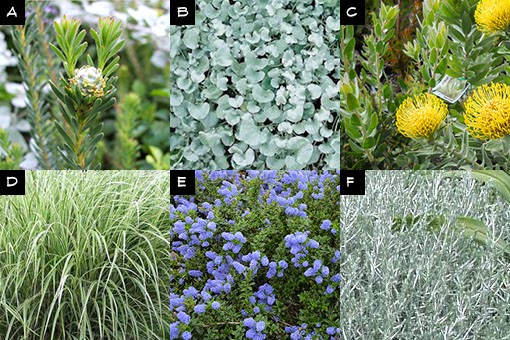
Berkeley Horticultural Nursery has quite a few Leucadendron linifolium, with delicate silvery green upright branching arms and fine needle-like foliage (top left image). Overall, there isn't much information online about this rare plant. Apparently, after they get older, they loose their delicateness and get a bit stiffer (bottom image). I also found a picture of the plant with bright orange foliage, but I don't know too much about the conditions in which it would do this. It also produces silver cone-like flowers.

To enhance its silver tones, A) Leucadendron linifolium could go nicely with B) Dichondra argentea 'Silver Falls', C) Leucospermum cordifolium 'Yellow Bird' (also with silvery green foliage), D) Miscanthus sinensis 'Variegatus,' E) Ceanothus 'Joyce Coulter' (for some contrast), and F) Leucophyta brownii. This could be lovely in front of a celadon green Berkeley bungalow. 

Details:
Biological Name: Leucadendron linifolium
Common Name: NCN
Family: Proteaceae (Proteas)
Origin: South Africa
Exposure: Full Sun
Irrigation: Low to Moderate Water Needs
Flower Time: Spring
Height: 4’
Width: 4’

#6) Grevillea 'Long John'


I was drawn to this shrub at Berkeley Horticultural Nursery and attracted to its long upright branches, thin needle-like foliage, and cinnamon colored bark. And, I can't say I'm surprised to find out that this is a huge shrub (8-10' h x w). If I was ever at a loss for screening plants that take full sun, I am no longer.

To me, this shrub has kind of a woodsy vibe, and I thought it would be fun to pair it with woodsy plants that also like some sun.


A) Grevillea 'Long John' could be paired with plants that bring out its blue hues, such as B) Cupressus cashmeriana, D) Juniperus horizontalis 'BlueChip', and F) Nolina nelsonii, as well as green plants such as C) Arctostaphylos densiflora 'Howard McMinn' (which shares its bark color) and E) Ribes sanguineum (which brings a broader and more delicate leaf to the mix). Woodsy, sun-loving and I love the blue-green hues. I want to do this!

Details:
Biological Name: Grevillea 'Long John'
Common Name: NCN
Family: Proteaceae (Proteas)
Origin: Australia (Australasia)
Exposure: Full Sun to Light Shade
Irrigation: Low Water Needs
Flower Time: Spring
Height: 8-10’
Width: 8-12’

Wednesday, October 15, 2014

#5) Beschorneria yuccoides


When I saw this plant many years ago in Los Angeles, it struck me as a cross between Agave americana and Phormium tenax. It had the structural form of the first, with the soft, cascading blades of the second. It was grouped en masse, completely blanketing a hillside, making a subdued yet undeniable statement. The bold design perfectly set off, and yet at the same time blended in, the new modern house on the block with its surroundings. At that time, I had no idea what this plant was. Since then, I've seen it lightly sprinkled around the East Bay and its nurseries. 

In terms of behavior, Beschorneria yuccoides clumps over time, sending out pups at the center to eventually become a rounded mass. It sends out red flowering stalks, that contrast its gray green leaves beautifully. Thankfully, when the stalk withers, the plant itself stays intact. 

At the UC Botanical Garden at Berkeley, they have a Beschorneria yuccoides by the front gate, which is the best application that I've seen in these parts. It sits at the corner of the planting bed, surrounded by a towering Otatea acuminata aztecorum (on its right), and a stunning Agave whipplei (on its left). Learning from this example, this broad-leafed plant pairs well with fine leafed plants, in a roomy spot that can show off its form. Another great perk is that it won't poke anybody's eye out.

Details:
Biological Name: Beschorneria yuccoides
Common Name: Amole
Family: Agavaceae (Agaves)
Origin: Mexico (North America)
Exposure: Full Sun
Irrigation: Low Water Needs
Flower Time: Summer
Height: 4-6’
Width: 4-6’

#4) Cussonia spicata

I've admired this plant for many years, and have thoughts several times how nice it could look in my garden. I love it's broad gray green leaves, with their complex geometric form.

I assumed it was a small or medium sized shrub, but as it turns out, it's a tree! In its native country (South Africa), it can get incredibly large, branching off into a candelabra shape. I'd imagine that it would take many decades for this to happen. Branches can also fall off older trees, and produce cone-like flower stalks.

For landscape purposes, I've only seen this tree with a single trunk, which doesn't initially appeal to me. But, after giving this a little more thought, A) Cussonia spicata can be used much like a palm tree... in groupings, with trees differing in height/ages. And, one could underplant with other South African plants, such as B) Zamia furfuracea, C) Melianthus major, and D) Aloe ferox. The trees could look especially appealing along both sides of a walk, or against a prominent wall.

Details:
Biological Name: Cussonia spicata
Common Name: Cabbage-tree
Family: Araliaceae (Ginsengs)
Origin: South Africa (Africa)
Exposure: Sun or Shade
Irrigation: Medium Water Needs
Flower Time: Spring/Summer
Height: 25-40’
Width: 15-30’

Tuesday, October 14, 2014

#3) Berberis thunbergii and cultivars


There was a plant that caught my eye at Berkeley Horticultural Nursery that seemed so wonderfully fall-like, and it turned out to be Berberis thunbergii 'Anderson.' For whatever reason, there isn't a lot of information online about this cultivar.

This piqued my interest in Berberis thunbergii and how beautiful it can be, especially as an indicator of the seasons. Through all its seasonal changes, from its vibrant yellow blooms, to it's twiggy/red berry stage, and sending out bright new shoots, it's always beautiful and interesting. Perhaps I'm late to this party, but I think I'm in love.

Behold the glory of the Barberry: A) Berberis thunbergii (love the green with the yellow), (B) Berberis thunbergii 'Rose Glow', (C) Berberis thunbergii, (D) Berberis thunbergii 'Atropurpurea Nana'.


It is even quite shade-tolerant and deer resistant. There's nothing that I don't like about these plants. The thorns are even manageable as long as they are kept away from paths. Perhaps the only fact that I find troubling is that it is considered invasive on the East Coast. Something to keep an eye on.

Berberis thunbergii, such as (A) 'Green Carpet' would look great in a Napa-like planting scheme, with (B) Vitis 'Roger's Red', Platanus racemosa, (D) Olea europaea, and (E) Muhlenbergia rigens, celebrating the seasons and the dry California landscape.