Showing posts with label Medium. Show all posts

Monday, December 8, 2014

#24) Epilobium canum


I saw this wonder of a plant at The San Francisco Botanical Garden this past October. It is Epilobium canum and thankfully, it is very much widely available. I was attracted to the drama of its bright red flowers against its silver foliage, as well as its soft form and wonderful application (in the middle of paving, anchoring 2 different levels). It demanded to be noticed!

At the two opposite ends of the spectrum, the straight species (A) has gray green foliage, while 'Catalina' (D) has silver foliage. Cultivars 'Bert's Bluff (B) and 'UC Hybrid' (C) are varying shades in between. These shades could prove useful in different plant palettes.

Hummingbirds love this plant. And, it can be used in California Native plant palettes. And, since this plant likes a cooler sun, I think it'll do great in Berkeley.

Details:
Biological Name: Epilobium canum or Zauschneria californica
Common Name: California Fuchsia
Family: Onagraceae
Origin: California (U.S.A.)
Exposure: Full Sun
Irrigation: Low Water Needs
Flower Time: Summer/Fall
Height: 1-2’
Width: 4-5’

Sunday, November 2, 2014

#19) Zamia spp.

I was drawn to this species for its upright habit, strong form, and cardboard-like leaves. It adds textural and structural interest to the shade garden. I used to see Zamia furfuracea frequently in Los Angeles nurseries, and I feel this plant could be more widely used in the Bay Area, as it is versatile to both sun or shade. Zamia pumila (top and bottom left images) has narrower leaflets than Zamia furfuracea (lower right image) and similarly, females produce orange cones. 

However, this species does not seem to be widely available here. Zamia pumila can be found on the Monrovia website, but otherwise seems hard to find. Devil Mountain Nursery carries Zamia floridana ‘North Strain' (though it does not have an image), and San Marcos Growers USED to carry Zamia furfuracea. Therefore, I'm not filled with confidence that I could acquire these if I wanted to. Perhaps they can be swapped with the more common Cycas revoluta (Sago Palm).

Zamia spp. is part of a plant palette called 'Parade of Shade.' Click on label/tag to see complete palette.

Details:
Biological Name: Zamia spp.
Common Name: Coontie
Family: Zamiaceae
Origin: West Indies and Cuba
Exposure: Full sun to partial shade*
Irrigation: Low Water Needs
Flower Time: Prized for foliage
* Devil Mountain and San Marcos suggest it can also handle full shade.

#18) Dianella tasmanica 'Variegata'

Dianella tasmanica 'Variegata' is a shade-loving plant that offers a bright splash in a potentially dark spot, as well as pattern interest with its varigated leaves. Like its straight species, it also produces blue star-shaped flowers followed by blue berries.

Monrovia suggests that it can be paired with broad-leafed and bronze-colored shade-loving plants, which sounded so lovely that I'd like to offer an alternative palette. Plants include A) Farfugium japonicum 'Gigantea', B) Dianella tasmanica 'Variegata', and C) Heuchera villosa 'Bronze Wave'. What a sophisticated combination!

Dianella tasmanica 'Variegata' is part of a plant palette called 'Parade of Shade.' Click on label/tag to see complete palette.

Details:
Biological Name: Dianella tasmanica 'Variegata'
Common Name: Variegated Flax Lily
Family: Phormiaceae
Origin: Australia (Australasia)
Exposure: Full shade to partial sun
Irrigation: Moderate Water Needs*
Flower Time: Summer
Height: 3-4’
Width: 3-4’
*Monrovia suggests it needs constant moisture, but other sites specify moderate watering.

#17) Woodwardia fimbriata

I was attracted to Woodwardia fimbriata for its fine, delicate foliage. It also adds height and texture to a shady garden. It got its name Giant Chain Fern for the chain-like spore pattern underneath its fronds.

Woodwardia fimbriata is part of a plant palette called 'Parade of Shade.' Click on label/tag to see complete palette.

Details:
Biological Name: Woodwardia fimbriata
Common Name: Giant Chain Fern
Family: Blechnaceae
Origin: Western North America
Exposure: Full shade to partial sun
Irrigation: Regular to ample water
Flower Time: Inconspicuous/none
Height: 3-6’*
Width: 3-6’*
* Typically 4 x 4’ in garden setting

Wednesday, October 29, 2014

#15) Dryopteris erythrosora

In continued effort to find interesting shade loving plants, I was excited to find Dryopteris erythrosora, one of the few ferns with seasonal color.

(A) Dryopteris erythrosora displays seasonal color when young, then matures to a deep green. Inspired by its muted seasonal color, I've paired it here with (B) Carex albula ‘Frosty Curls’, (C) Salix babylonica (Weeping Willow Tree) and (D) Corylus avellana 'Contorta'. This plant palette was inspired by the austere riparian beauty of the Marin headlands. Dryopteris erythrosora is available at Devil Mountain Nursery.

Details:
Biological Name: Dryopteris erythrosora
Common Name: Autumn Fern
Family: Dryopteridaceae
Origin: Japan (Asia)
Exposure: Partial to Full Shade
Irrigation: Medium Water Needs
Flower Time: Does not flower
Height: 1.5-3’
Width: 1.5-2’

#14) Farfugium japonicum

After covering 13 'full sun' plants, I thought I'd switch gears a bit and focus on shade plants. This beautiful planting is outside Flowerland in Berkeley. The broad leaf plant in the center is Farfugium japonicum 'Gigantea'. It reaches 3-4' high and wide, likes cool sun/light shade, and medium amounts of water. Here it is paired with (left to right) Carex trifida 'Rekohu Sunrise', Gunnera spp., and Asparagus retrofractus, in a subtly Japanese-inspired palette.


Along with (A) Farfugium japonicum 'Gigantea', there is also (B) Farfugium japonicum 'Aureo-maculata', with yellow spots on its leaves. These plants are dying to be reinterpretted in a modern landscape!

Details:
Biological Name: Farfugium japonicum 'Gigantea'
Common Name: Giant Leopard Plant
Family: Asteraceae (Sunflowers)
Origin: Japan (Asia)
Exposure: Cool Sun/Light Shade
Irrigation: Medium Water Needs
Flower Time: Summer/Fall
Height: 3-4’
Width: 2-3’

Tuesday, October 21, 2014

#12) Agave 'Blue Glow'

Agave 'Blue Glow' is a beautiful succulent that stays low and compact. The prettiest thing about it is its yellow and red margins. It's especially beautiful when backlit by the sun.

This planting scheme is particularly successful for a few reasons. Instead of en massed in a tight grid, this single specimen succulent has a more informal effect. I like how it is grounded by the boulder, as well as the contrasting softness of the surrounding foliage. Tonally, it is also really nice – the blue of the Agave is complimented by the bright orange of the Carex testacea, and hues of silver (Helichrysum petiolare), gray green (Lavandula dentata and Festuca glauca), and bright green soften the contrast. Kudos to Verdance Design.

It's also worth noting that the Carex testacea is well placed directly behind the Agave 'Blue Glow', along the top edge of the burm. Its yellow coloring adds to the back lit effect, and distinguishes its spikey form. This plant is available at Devil Mountain Nursery.

Details:
Biological Name: Agave 'Blue Glow'
Common Name: Blue Glow Agave
Family: Agavaceae (Agaves)
Origin: Mexico (North America)
Exposure: Full Sun
Irrigation: Low Water Needs
Flower Time: Infrequent
Height: 1-2’
Width: 2-3’

Saturday, October 18, 2014

#7) Leucadendron linifolium

Berkeley Horticultural Nursery has quite a few Leucadendron linifolium, with delicate silvery green upright branching arms and fine needle-like foliage (top left image). Overall, there isn't much information online about this rare plant. Apparently, after they get older, they loose their delicateness and get a bit stiffer (bottom image). I also found a picture of the plant with bright orange foliage, but I don't know too much about the conditions in which it would do this. It also produces silver cone-like flowers.

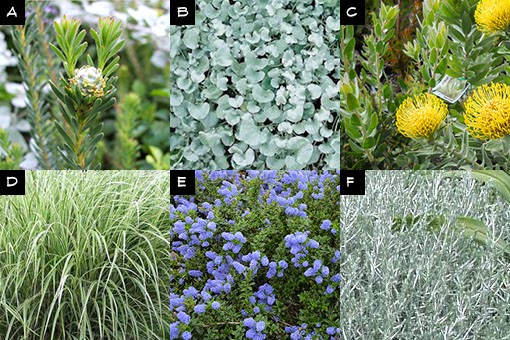
To enhance its silver tones, A) Leucadendron linifolium could go nicely with B) Dichondra argentea 'Silver Falls', C) Leucospermum cordifolium 'Yellow Bird' (also with silvery green foliage), D) Miscanthus sinensis 'Variegatus,' E) Ceanothus 'Joyce Coulter' (for some contrast), and F) Leucophyta brownii. This could be lovely in front of a celadon green Berkeley bungalow. 

Details:
Biological Name: Leucadendron linifolium
Common Name: NCN
Family: Proteaceae (Proteas)
Origin: South Africa
Exposure: Full Sun
Irrigation: Low to Moderate Water Needs
Flower Time: Spring
Height: 4’
Width: 4’

Wednesday, October 15, 2014

#5) Beschorneria yuccoides


When I saw this plant many years ago in Los Angeles, it struck me as a cross between Agave americana and Phormium tenax. It had the structural form of the first, with the soft, cascading blades of the second. It was grouped en masse, completely blanketing a hillside, making a subdued yet undeniable statement. The bold design perfectly set off, and yet at the same time blended in, the new modern house on the block with its surroundings. At that time, I had no idea what this plant was. Since then, I've seen it lightly sprinkled around the East Bay and its nurseries. 

In terms of behavior, Beschorneria yuccoides clumps over time, sending out pups at the center to eventually become a rounded mass. It sends out red flowering stalks, that contrast its gray green leaves beautifully. Thankfully, when the stalk withers, the plant itself stays intact. 

At the UC Botanical Garden at Berkeley, they have a Beschorneria yuccoides by the front gate, which is the best application that I've seen in these parts. It sits at the corner of the planting bed, surrounded by a towering Otatea acuminata aztecorum (on its right), and a stunning Agave whipplei (on its left). Learning from this example, this broad-leafed plant pairs well with fine leafed plants, in a roomy spot that can show off its form. Another great perk is that it won't poke anybody's eye out.

Details:
Biological Name: Beschorneria yuccoides
Common Name: Amole
Family: Agavaceae (Agaves)
Origin: Mexico (North America)
Exposure: Full Sun
Irrigation: Low Water Needs
Flower Time: Summer
Height: 4-6’
Width: 4-6’